 Clearwater Roofing
 Why Clearwater Beach Decks Take More Abuse Than Most
A deck on Clearwater Beach lives a harder life than one a few miles inland. You're dealing with direct Gulf salt spray, reflected UV off open water almost year-round, wind-driven rain that finds every gap in flashing, and gusts that regularly outrun what a typical residential deck was built to shrug off decades ago. None of that is exotic — it's just Pinellas County barrier island weather — but it means a deck built to a generic national spec will show wear here faster than the same product would in a drier, calmer climate.
Composite decking earns its keep in this environment because it doesn't rot, splinter, or need annual staining the way wood does. But composite is not maintenance-free or install-proof. The board itself is only part of the system. The framing underneath it, the fasteners holding it down, the flashing where it meets the house, and the way it's spaced for drainage all determine whether a Clearwater Beach composite deck lasts 25 years or starts failing at year eight.
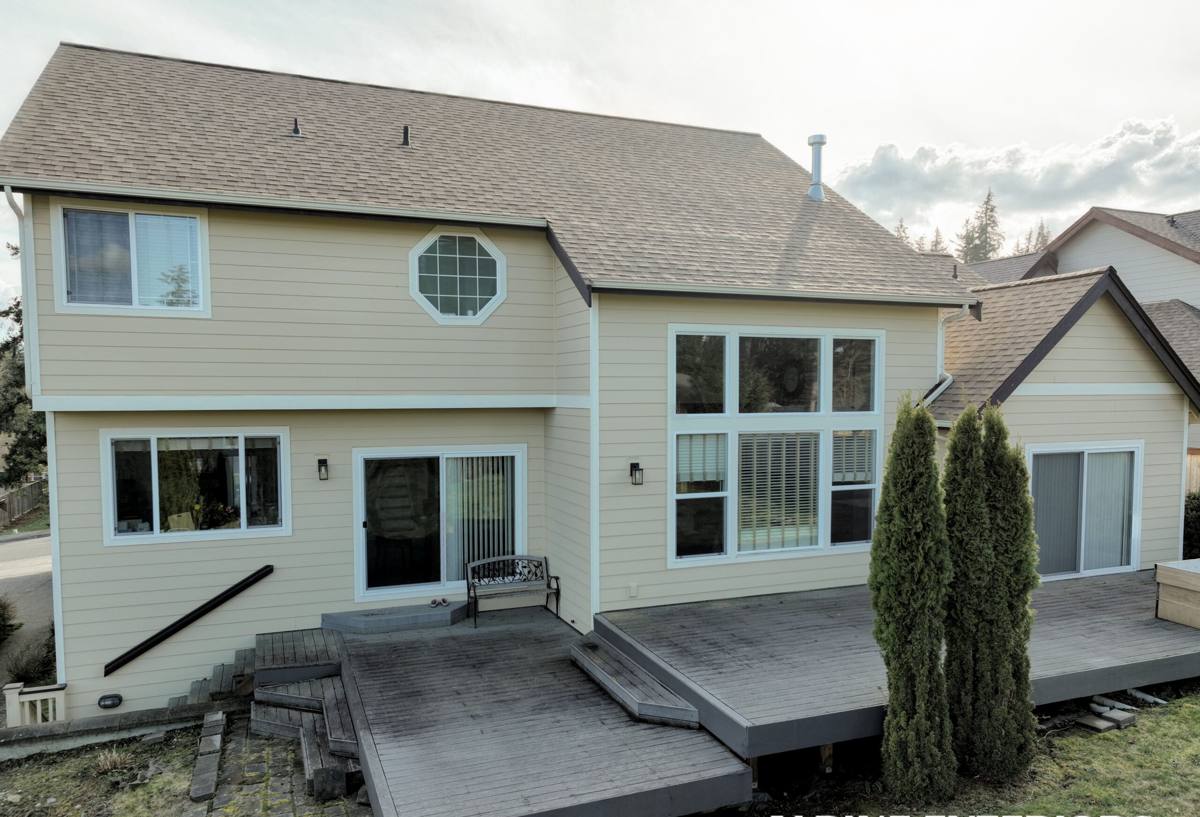
What Salt Air and Sun Actually Do to a Deck Here
Salt Air and Corrosion
Airborne salt doesn't just sit on the surface — it works into fastener heads, hinges, railing brackets, and any exposed metal. Standard coated deck screws that hold up fine forty miles inland can start rusting and staining composite boards within a couple of seasons this close to the water. It's one of the most common complaints we hear from homeowners who had a deck built by a crew that doesn't normally work beachside: rust streaks bleeding through light-colored composite boards around every fastener.
UV and Heat
Clearwater Beach gets long, intense sun exposure with very little natural shade over open decks. UV breaks down uncapped or lower-grade composite surfaces over time, causing fading and a rougher, chalkier texture. Dark-colored boards also run noticeably hotter underfoot in summer — worth factoring into color choice, not just for comfort but because heat cycling accelerates expansion and contraction in the boards.
Wind and Wind-Driven Rain
Pinellas County sits in Florida's wind-borne debris region, and beachfront exposure means a deck here sees higher sustained wind loads than one set back from the coast. Railings, ledger connections, and fastening patterns all need to account for that. Wind-driven rain also pushes water sideways and upward under boards and around ledger flashing in ways a calm-weather rain never would — which is why drainage and flashing details matter more here than in most parts of the country.
Composite Board Options — What the Differences Actually Mean
Not all composite decking is built the same, and the differences matter more in a coastal environment than they would somewhere drier and shadier. Here's how the common tiers compare for a Clearwater Beach application:
| Board Type | Moisture & Salt Performance | Fade Resistance | Typical Warranty | Best Fit |
|---|---|---|---|---|
| Uncapped composite | Absorbs moisture at cut ends and edges over time | Fades and can mold/mildew faster in humid salt air | Shorter, prorated | Budget-driven inland projects, not ideal beachside |
| Capped composite | Polymer shell resists moisture intrusion at the face | Good; cut ends still need sealing or capped edge trim | 25-30 years typical | Solid mid-range choice for most Clearwater Beach decks |
| Solid PVC / cellular PVC | No wood content — essentially immune to moisture and rot | Very good with quality UV-stabilized formulations | Often 25+ years, sometimes lifetime on the material | Best long-term option for full sun and heavy salt exposure |
We don't push one brand over another as a sales pitch — we spec the tier that matches the site. A shaded, landward deck can reasonably use a mid-grade capped composite. A deck taking direct salt spray and full afternoon sun on the beach side gets a stronger recommendation toward a fully capped or PVC product, because the cost difference over the life of the deck is smaller than it looks on day one.
What a Correct Install Involves Beneath the Boards
Framing and Substructure
Composite boards are only as good as what they're screwed into. Pressure-treated joists are standard, but in a high-salt environment the fastener and connector hardware matter as much as the wood — we use stainless steel or coated fasteners rated for coastal/marine exposure, not standard interior-grade hardware. Where budget and design allow, aluminum framing systems are worth discussing, since they remove wood-rot and fastener-corrosion risk from the equation entirely.
Ledger Flashing
Where a deck attaches to the house, the ledger board and its flashing are the single most common source of hidden water damage — not just on decks, but on homes generally. Wind-driven rain off the Gulf pushes water into gaps that would stay dry in calmer climates. Proper step flashing and a continuous water-resistive barrier at that connection point are non-negotiable, even though nobody sees them once the deck is finished.
Drainage and Board Spacing
Composite boards need consistent gapping for water to shed and airflow to reach the underside — tight or inconsistent spacing traps moisture against the framing and can void manufacturer warranties. On grade-level or low-clearance decks common near the beach, we pay extra attention to slope and under-deck drainage so standing water isn't sitting against joists after a summer downpour.
Expansion and Fastening
Composite expands and contracts with heat more than wood does, and Clearwater Beach decks see big daily temperature swings on the surface even when the air temperature is mild. Hidden fastener clip systems, correct end-gapping, and picture-frame border details all need to account for that movement, or you end up with buckling or popped fasteners within a few summers.
Our Process for a Clearwater Beach Composite Deck
- On-site assessment — we look at sun exposure, wind exposure, proximity to the water, existing framing condition if this is a rebuild, and how the deck ties into the house.
- Material recommendation — we walk through board tier options honestly, including what each one costs to buy versus what it costs to maintain over 10-20 years in this climate.
- Permitting — decking work, especially anything involving structural framing, railings, or attachment to the home, typically requires a permit through the local building department; we handle that so you're not the one tracking it down.
- Framing and flashing — substructure repair or replacement, ledger flashing, and corrosion-resistant hardware installed to coastal standards, not generic inland defaults.
- Decking installation — correct spacing, hidden fastening, expansion gaps, and border/trim detailing for a clean finished look that also performs.
- Final walkthrough — we go over basic composite care with you (cleaning, what to keep off the surface, how to spot early fastener or flashing issues) so small things get caught early.
Why a Crew That Already Works Clearwater Beach Matters
A contractor based inland can absolutely build a technically sound deck — on paper. What tends to get missed is the coastal-specific detailing: the fastener grade, the framing hardware, the flashing approach for wind-driven rain, and realistic expectations about how a given board color and tier will hold up under this much sun and salt. A crew that regularly works Clearwater Beach and the surrounding Pinellas County coastline has already seen which shortcuts show up as problems in year two or three, and builds around them from the start rather than learning on your project.
Local also means faster response if something needs a look after a storm — checking flashing, fastener condition, or storm-related debris impact — instead of waiting on a crew that has to drive in from across the county.
Signs an Existing Deck Needs Attention Before Next Storm Season
- Rust streaking around fastener heads or hardware, especially on lighter-colored boards
- Soft spots, gaps, or visible movement where the deck meets the house at the ledger board
- Boards that have visibly faded, chalked, or gone rough-textured compared to when installed
- Standing water under the deck after rain instead of draining away within a few hours
- Railings or posts that feel loose or flex more than they used to
- Any wood framing visible from below showing dark staining, softness, or insect activity
None of these mean the whole deck needs to be torn out — sometimes it's a flashing repair or a hardware upgrade. But left alone through another hurricane season, small issues like these are what turn into full rebuilds.
What This Typically Involves Cost-Wise
Composite decking projects vary widely based on square footage, framing condition, railing style, and board tier chosen, so we'd rather give you an honest number after seeing the site than a generic figure that doesn't hold up. In broad terms, expect composite to cost more upfront than pressure-treated wood but significantly less over time once you factor out sanding, staining, and the wood replacement that salt-air exposure tends to accelerate. We'll lay out the real trade-offs for your specific deck during the estimate rather than steering you toward the most expensive option by default.
If you're planning a new composite deck for a Clearwater Beach property, or you've got an existing deck showing wear from a season or two of Gulf sun and salt air, we're happy to take a look and give you a straightforward, no-pressure estimate — just fill out the form below.