 Clearwater Roofing
 Why Belleair Decks Wear Out Faster Than the Manual Says
Belleair sits close enough to Clearwater Harbor and the Intracoastal that salt-laden air reaches almost every property, not just the waterfront ones. Add in Pinellas County's intense year-round UV index, sudden wind-driven downpours, and the occasional hurricane-force wind event, and you have a climate that ages outdoor structures faster than the warranty paperwork ever assumes. A deck built to a generic national spec, or one that was fine for a drier, cooler climate, tends to show its age here in years rather than decades.
We replace decks throughout the Belleair area regularly enough to know which failures are climate-driven and which are installation shortcuts. Both matter when you're deciding whether to repair, resurface, or fully replace.
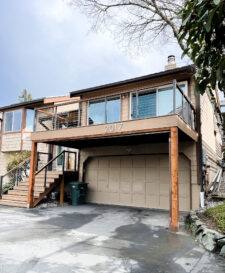
What Belleair's Climate Actually Does to a Deck
Salt Air and Metal Fasteners
Salt-laden coastal air accelerates corrosion in fasteners, brackets, and structural hardware. On an older deck, this often shows up first at the ledger board connection and post bases — the parts you can't see without getting underneath the structure. Corroded fasteners lose holding strength quietly, long before any visible sagging or wobble appears.
UV Exposure
Florida sun breaks down the surface fibers of wood decking and dries out the plasticizers in some composite products, leading to graying, splintering, or surface chalking. Full southern and western exposures, common on many Belleair lots, see the fastest breakdown.
Wind-Driven Rain and Moisture Cycling
Afternoon storms don't just wet the deck surface — wind-driven rain gets pushed sideways into joints, under boards, and into end grain. Combined with Florida's humidity, this creates repeated wet-dry cycling that's harder on materials than constant moisture would be, because it stresses the wood or composite with expansion and contraction every single day.
Hurricane and Straight-Line Wind Loads
Pinellas County's wind exposure means a deck attached to your home has to handle real uplift and lateral load, not just support foot traffic. An older deck built before current attachment standards were tightened often has a ledger connection, guard post, or stair stringer that was never engineered for those forces.
Signs a Belleair Deck Needs Replacement, Not Repair
- Soft, spongy, or spring-back decking when you walk across it, especially near the house
- Visible rust streaking below fastener heads or around post bases
- Gaps that have widened significantly between boards, or boards that have cupped or crowned
- A ledger board that shows any separation from the house rim joist, even hairline
- Guard rail posts that flex noticeably when pushed
- Stair stringers with visible splitting near the notches
- A deck more than 15-20 years old that has never had the substructure inspected
- Persistent mildew or discoloration in shaded areas that pressure washing no longer removes
If what you're seeing is limited to a handful of surface boards and the framing underneath is sound, resurfacing can be a legitimate option. If the framing, ledger connection, or footings are compromised, resurfacing just puts new material on a bad foundation — and in a wind event, the foundation is what matters most.
What a Correct Deck Replacement Involves in This Climate
Ledger Board Attachment
The ledger — where the deck attaches to your house — is the single most safety-critical connection on the structure. It needs proper flashing to keep water from migrating into the house's rim joist, and lag bolts or through-bolts sized and spaced for real wind and load conditions, not just what happened to be on the original build.
Footings and Post Bases
Post bases should sit above grade on properly sized footings, using hardware rated for exterior and coastal exposure. In areas with poor drainage or high water tables, footing depth and design need extra attention so the structure doesn't shift over time.
Framing Hardware
Joist hangers, structural screws, and connector hardware should be hot-dip galvanized or stainless rated for coastal use — not the standard-grade hardware that's fine two counties inland but corrodes within a few seasons here.
Decking Material Selection
Wood, composite, and PVC decking each behave differently under Florida sun and salt air. We'll walk through the real trade-offs for your specific deck rather than pushing one product — see the comparison below.
Guard Rails and Stairs
Rail post attachment is a common weak point on older decks and a frequent source of rejected inspections. Replacement is the right time to bring these up to current spacing and load requirements.
Decking Material Comparison for Belleair Conditions
| Material | UV/Salt Air Behavior | Maintenance | Typical Lifespan Here |
|---|---|---|---|
| Pressure-treated wood | Prone to graying, splintering, and checking under intense UV; needs sealing to resist moisture cycling | Annual cleaning and periodic sealing/staining | 10-15 years with upkeep |
| Composite decking | Holds color better than wood but quality varies widely; lower-grade composites can fade or the surface can degrade under sustained UV | Periodic cleaning, no sealing required | 20-25+ years, varies by product grade |
| PVC/cellular decking | Fully synthetic, most resistant to moisture cycling and salt exposure; less prone to fading than lower-grade composites | Low — occasional washing | 25-30+ years |
| Tropical hardwood (e.g. ipe) | Naturally dense and rot-resistant, but still needs oiling to prevent surface graying in full sun | Regular oiling to maintain appearance | 20-25+ years structurally |
Lifespan figures are general ranges, not guarantees — actual performance depends on sun exposure, drainage under the deck, and how consistently a homeowner keeps up with the maintenance a given material requires. We'll give you honest numbers for your specific site and orientation during the estimate.
Our Deck Replacement Process
1. On-Site Assessment
We inspect the existing deck from underneath as well as on the surface — ledger connection, footings, joist condition, and any moisture intrusion into the house structure itself. This tells us whether replacement is actually necessary and what the new structure needs to account for.
2. Design and Material Selection
We talk through decking material, rail style, and layout based on your budget, how you use the space, and the exposure your specific lot gets. We're candid about which materials fit which budgets and which trade-offs come with each.
3. Permitting
Deck replacement in Pinellas County typically requires a permit, particularly for any structural attachment to the home. We handle the permitting and inspection process so the finished structure is properly documented — which also matters for insurance and future resale.
4. Demolition and Structural Rebuild
Old decking, framing, and hardware are removed down to what's actually sound. Ledger, footings, and framing are rebuilt or reinforced to current standards before any new decking goes down.
5. Decking, Rail, and Stair Installation
Installed per manufacturer spacing and fastening specs — this matters more with composite and PVC products than most homeowners realize, since incorrect gapping or fastening is a leading cause of premature warranty claims.
6. Final Walkthrough
We walk the finished deck with you, cover basic care for whatever material you chose, and make sure everything meets both code and your expectations before we call the job done.
Cost Factors for a Belleair Deck Replacement
- Size and footprint — square footage is the baseline driver of material and labor cost
- Decking material — pressure-treated wood, composite, and PVC span a wide price range
- Height and multi-level design — elevated or multi-level decks require more substructure and railing
- Existing structural condition — how much of the old framing and footings can be reused versus rebuilt
- Rail and stair complexity — custom rail styles and multiple stair access points add cost
- Permitting requirements — structural attachment and elevation both affect permit scope
- Site access — tight side yards or waterfront access can affect equipment and labor time
We don't quote a number until we've actually looked at your deck. Broad ranges without a site visit tend to be wrong in one direction or the other, and we'd rather give you an accurate figure than a fast one.
Why Hire a Crew That Already Works in Belleair
A contractor who works Pinellas County's coastal neighborhoods regularly already knows which hardware grades hold up to salt air, which decking products actually perform under this UV load rather than just being rated for it on paper, and what the local permitting process expects for ledger attachment and wind load documentation. That familiarity shows up in fewer inspection callbacks, fewer surprises once demolition starts, and a deck that's actually built for the conditions it's going to sit in — not a generic spec pulled from a national install guide.
It also matters for accountability. A crew with an ongoing presence in the area has a reputation to protect with your neighbors, not just with you.
Get a Free Estimate for Your Belleair Deck
If your deck is showing its age, feels less solid than it used to, or you're just ready for something built to actually handle Clearwater's sun, salt air, and storm season, we're happy to take a look. The estimate is free, there's no pressure, and you'll get a straight answer about whether you need a full replacement or something less. Use the form below to get started.